

KAMPALA, UGANDA — For more than six decades, dfcu Bank has been part of Uganda’s economic journey, financing businesses, supporting entrepreneurs and expanding access to financial services. Now, the institution seeks to better measure what that contribution has meant for the country and its people.
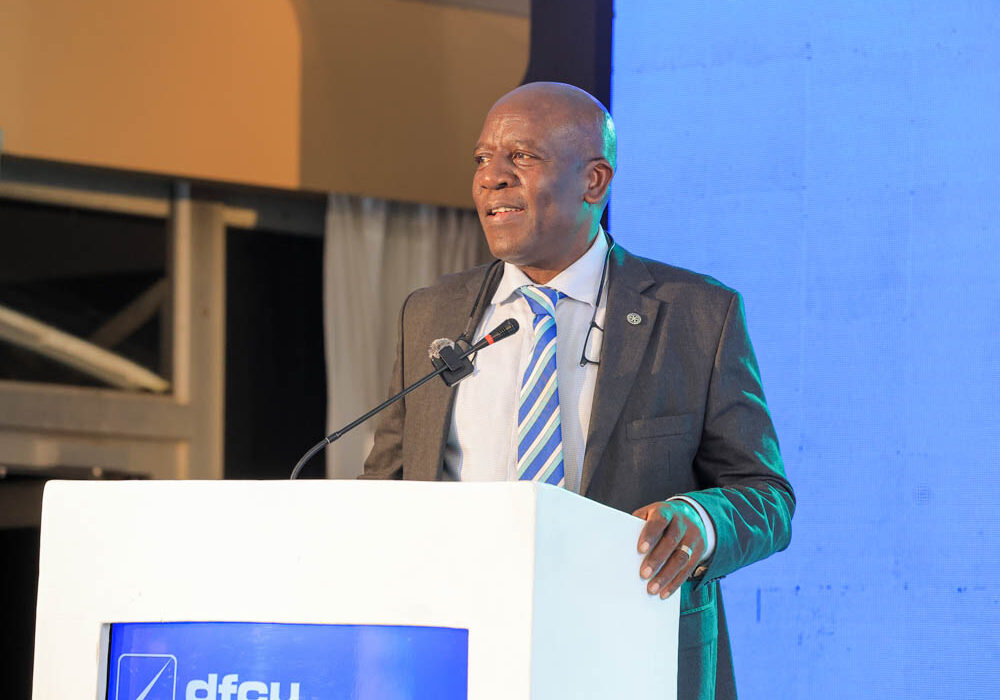
At a gathering of business leaders, development partners and stakeholders at Serena Hotel, Kigo, on Tuesday evening, dfcu Bank unveiled its inaugural Report to Society 2025, signaling a renewed commitment to transparency, accountability and responsible banking.
The publication marks a shift in how the institution presents its performance, looking beyond profits and financial growth to examine the opportunities created, businesses supported and communities reached through its operations and partnerships.
It also raises a broader question for Uganda’s financial sector: How should banks account for the difference they make in the lives of the people they serve?
Putting people behind the numbers
For dfcu Bank Board Chairperson Prof. Winifred Tarinyeba Kiryabwire, the report represents an opportunity to make the institution’s contribution more visible while giving stakeholders a stronger basis for evaluating its performance.
“For more than six decades, dfcu has been part of Uganda’s economic transformation, supporting businesses, expanding financial inclusion and creating opportunities for individuals and communities,” she said.
She emphasised that the responsibility of a financial institution extends beyond generating returns for shareholders to creating sustainable value for the wider society.
“We are sharing these results not simply to celebrate our progress, but to give our stakeholders a basis on which to assess our contribution and challenge us to do more,” she added.

That approach reflects growing expectations among customers, regulators, investors and communities for businesses to demonstrate not only financial strength but also responsible governance and measurable social impact.
The report brings together dfcu’s interventions in enterprise financing, women’s economic empowerment, agricultural development, healthcare and environmental stewardship, providing a consolidated account of its contribution to Uganda’s development.
From financial services to real economic impact
The figures presented offer a picture of the scale of dfcu’s activities. In 2025, the Bank financed 6,527 small and medium-sized enterprises, supporting businesses across sectors that contribute to production, employment and trade.
Its Women in Business programme has supported more than 80,000 women entrepreneurs, reflecting efforts to address barriers to financial inclusion and strengthen women’s participation in the economy.
Beyond enterprise development, dfcu reported that its community health interventions had reached more than 25,000 Ugandans. Through a three-year partnership with Rotary Uganda, the Bank committed UGX 1 billion towards preventive healthcare, supporting medical camps offering consultations, diagnostic services, medicines, dental and eye care, and screening for conditions including hypertension, diabetes, HIV and cancer.
The initiatives demonstrate how corporate investment can extend beyond traditional banking relationships to address challenges affecting community wellbeing.
However, the longer-term significance of these interventions will depend on sustained delivery and the ability to demonstrate measurable improvements in people’s lives.
Banking on trust and responsibility
dfcu Bank Chief Executive Officer Charles Mudiwa placed trust at the centre of the institution’s decision to publish the report. He argued that sustainability is not simply a modern corporate concept, but a responsibility deeply rooted in the obligation to preserve resources and opportunities for future generations.
“Our customers and stakeholders entrust us with their money, their businesses and their confidence. We therefore have a responsibility to account for how we use those resources and what they help us achieve,” Mudiwa said.
He described the publication as the Bank’s first comprehensive effort to bring together its contribution to livelihoods, enterprises and communities in a form accessible to the public.
For Mudiwa, the challenge is to ensure that financial services translate into meaningful economic progress while maintaining the confidence of customers and stakeholders.

This places accountability alongside financial performance as a measure of institutional success.
Bridging the gap between business survival and growth
While access to capital remains a significant challenge for many Ugandan enterprises, the dfcu Foundation is increasingly focusing on another critical obstacle: helping promising businesses develop the capacity to grow sustainably.
Dr. James Ssemwanga, Chairman of the dfcu Foundation, highlighted the difficulties facing enterprises in the country’s so-called missing middle — businesses that have progressed beyond survival but lack the financing, technical capacity and market connections required to expand.
“Uganda’s economic growth depends not only on helping businesses start, but also on enabling promising enterprises to become stronger, more productive and more resilient,” he said.
According to Ssemwanga, access to finance alone is insufficient without the business skills, partnerships and market opportunities needed to sustain growth. Since 2018, the Foundation has supported more than 4,000 enterprises and reached over 80,000 beneficiaries, the majority being women and young people.
In 2025, it facilitated approximately UGX 38 billion in credit, connecting enterprises to formal financial services and opportunities for investment. The Foundation, which evolved from dfcu’s Business Development Centre in 2024, is targeting more than 100,000 additional beneficiaries between 2025 and 2030.
Its approach focuses on strengthening businesses and connecting them to value chains involving producers, processors, manufacturers, suppliers and markets.
Such interventions are particularly relevant to Uganda’s development ambitions, where the ability of small enterprises to expand into productive, competitive businesses remains central to employment creation and economic transformation.
A broader definition of corporate success
For Jimmy D. Mugerwa, Chairman of dfcu Limited, the holding company of dfcu Bank, the launch represents an important step in redefining how institutions communicate their contribution to society.
He said financial success and social responsibility should reinforce rather than compete with each other.
“For us, the long-term success of dfcu cannot be measured by financial results alone. It must also be reflected in the opportunities we help create, the resilience of the communities we serve and the contribution we make to Uganda’s economic future,” Mugerwa said.
He expressed hope that the initiative would encourage other businesses to adopt more transparent approaches to reporting their wider contribution.
“We hope this initiative encourages a wider culture of transparency in which responsible businesses report not only on what they earn, but also on what they contribute to society,” he added.

The report also documents dfcu’s environmental initiatives, including 62,000 trees reportedly planted or distributed in 2025. While the figures illustrate the scale of the institution’s environmental activities, measuring the long-term impact of such interventions will require continued attention to tree survival, maintenance and environmental outcomes.
Turning accountability into a lasting commitment
The launch comes as environmental, social and governance considerations increasingly shape expectations of financial institutions.
For banks, this means looking beyond the immediate profitability of transactions to consider how lending, investment and business decisions affect communities, livelihoods and the environment.
Helena Mayanja, dfcu Bank’s Head of Corporate Affairs and Sustainability, said the report was intended to connect the institution’s financial activities with the experiences of the people and enterprises benefiting from them.
“Behind every figure are people, enterprises and communities whose progress matters,” she said.
She emphasised the importance of credible measurement, transparent communication and continuous improvement in demonstrating institutional impact.
The event brought together leadership from dfcu Limited, dfcu Bank and dfcu Foundation, alongside customers, development partners and representatives of the business community.
Their discussions reflected a common theme: that responsible banking must be measured not only by the financial resources mobilised, but also by the opportunities those resources help create.
For an institution established in 1964 as a development finance organisation, the publication also reconnects dfcu’s present-day operations with its historical role in Uganda’s economic development.
Yet the real significance of the inaugural Report to Society may lie less in the achievements it documents than in the expectations it establishes for the future.
Publishing impact figures is an important first step. Demonstrating consistent progress, providing credible evidence and remaining open to public scrutiny will determine whether the initiative becomes a lasting instrument of accountability.
As Uganda pursues greater economic participation, enterprise development and sustainable growth, dfcu’s decision to publicly account for its societal contribution could help encourage a wider conversation about the responsibilities of financial institutions.
With the launch of the 2025 Report to Society, dfcu’, the ‘s message is clear: banking success should not end with a healthy balance sheet. It should also be reflected in stronger businesses, more resilient communities and opportunities that endure across generations. The challenge now is to demonstrate that impact, year after year.

About Memoir Uganda – Showcasing Uganda
We are a comprehensive tourism and travel media company unleashing information about Uganda. We offer, among others, an all-inclusive guide on everything Uganda, such as itineraries, consular information, timely and updated tour and travel news,s and general information about visiting and living in Uganda.
To us, Uganda is more than a tour destination. It is our homeland. Our knowledge about Uganda is ocean-deep, and we love showing the country’s splendid beauty to the world. We aim to share and showcase Uganda to the tiniest bit, better than anyone else. We also aim to conserve our homeland through our unwavering efforts towards climate change awareness.
Our Memoir Magazine showcases Uganda’s diverse potential in detail that is often left out and unknown. You ought never to miss a copy. We robustly believe that traveling should make the world a better place for everyone. Thee world a better place for everyone.